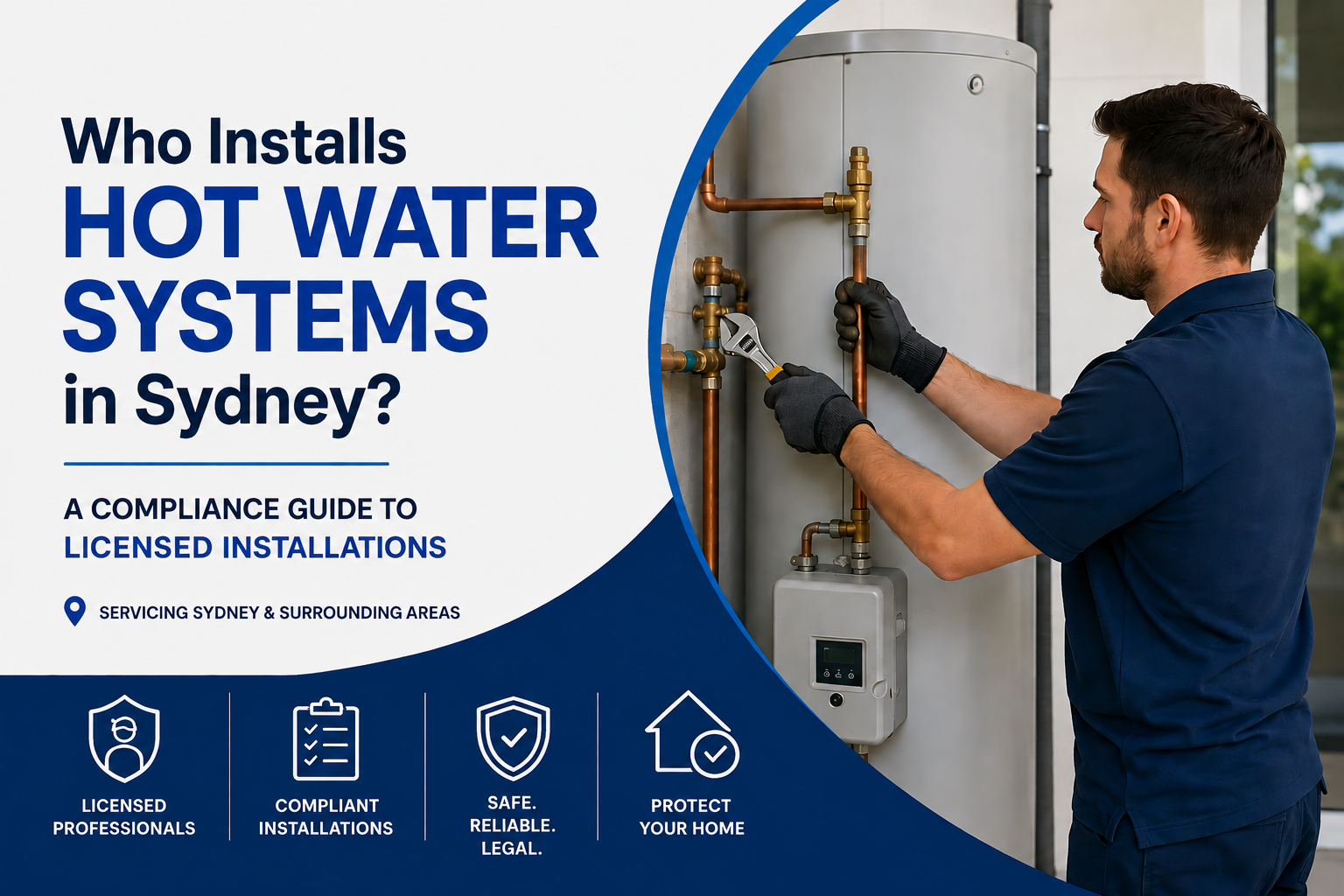
Who Installs Hot Water Systems in Sydney? A Compliance Guide to Licensed Installations
Date: August 31, 2026
If you’ve ever had a tradesman offer to “sort out” your hot water system for cash on a Saturday, you’ve probably also wondered: is that even legal? In NSW, the honest answer is no — not unless that person is carrying the right licence for the job.
Who installs hot water systems in Sydney? A NSW-licensed plumber must carry out every hot water installation. If the unit is electric or a heat pump, a licensed electrician has to complete the hardwiring. If it runs on gas, a licensed gas fitter is legally required to connect the gas line. Skip any of these steps, and you’re left with an installation that’s not just risky — it’s unenforceable if something goes wrong later, because no insurer or council will back unlicensed work.
That’s the short version. Here’s what it actually means for your home, your budget, and who you should be calling.
Why Hot Water Installation Isn’t a Handyman Job
Hot water systems sit at the intersection of two trades that are both tightly regulated for good reason. You’ve got pressurised water lines, and depending on the unit, either high-voltage wiring or a live gas connection running through your roof cavity, garage, or external wall.
A general handyman — however capable with a drill — isn’t authorised to touch either of those. NSW Fair Trading requires a licensed plumber for the water and drainage work, and a second, separately licensed trade for the power source. This isn’t red tape for its own sake. Get a tempering valve wrong, or a gas fitting slightly loose, and you’re looking at scalding risk or a gas leak, not just a warranty voided.
That’s why a proper hot water system installation should always come from a business that already holds both plumbing and gas-fitting licences in-house, rather than one that subcontracts out the “electrical bit” and hopes it gets done.
Required Licences by Fuel Type
Not every hot water system needs the same combination of tradespeople. Here’s how it breaks down:
| System Type | Who Must Install It |
| Electric Storage Tank | Licensed plumber for water connections, plus a licensed electrician for the wiring |
| Heat Pump | Licensed plumber, plus a licensed electrician for circuit wiring and controls |
| Gas Continuous Flow / Gas Storage | Licensed plumber with specialist gas-fitting accreditation |
| Solar Hot Water | Licensed plumber, often with an electrician for the pump or booster controls |
Gas systems are usually the strictest of the four, because the same person needs both a plumbing licence and a separate gas-fitting endorsement before they’re allowed to connect a gas line at all. A plumber without that extra ticket legally cannot touch the gas side of the job, even if they’ve fitted the tank itself.
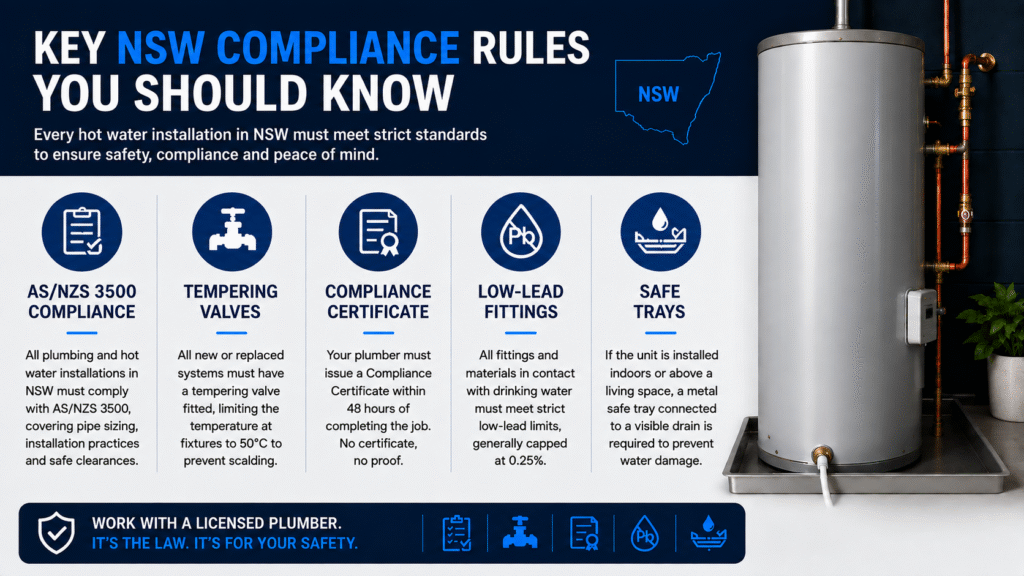
Key NSW Compliance Rules You Should Know
Even once you’ve got the right tradesperson on site, the job still has to meet a specific set of standards before it’s considered legal and safe. A few of the ones homeowners rarely hear about until something’s already gone wrong:
- AS/NZS 3500 compliance — every plumbing and hot water job in NSW has to follow this Australian Standard, covering everything from pipe sizing to safe installation clearances.
- Tempering valves — any new or replaced system needs one fitted, capping the water temperature at fixtures to 50°C so nobody gets scalded at the tap.
- Compliance certificate — your plumber is required to issue this within 48 hours of finishing the job. No certificate, no proof the work was done to standard.
- Low-lead fittings — anything touching your drinking water supply must sit under strict lead limits, generally capped at 0.25% in wetted surfaces.
- Safe trays — if the unit sits indoors or above a living space, it needs a metal safe tray plumbed to a visible drain, so a slow leak doesn’t turn into a ceiling collapse six months later.
Skip any one of these and technically the installation isn’t compliant, whether or not the unit is working fine today.
Gas, Electric, or Heat Pump: Which One Actually Suits Your Home?
This is usually the question that comes right after “who can install it” — and it depends more on your household’s hot water habits than on price alone.
Gas continuous flow heats water on demand rather than storing it, so you’re never rationing hot showers during a big family morning. It needs a gas fitter for the connection and tends to suit homes already on mains gas.
Electric storage tanks are the simplest to install and usually the cheapest upfront, but running costs can climb depending on your tariff, and you’re limited by tank size once it’s empty.
Heat pumps pull warmth from the air rather than generating it directly, which cuts running costs significantly over time. They also qualify for rebates under several NSW energy programs, which can offset a chunk of the install cost.
There’s no single “best” option here — it comes down to your gas access, household size, and whether upfront cost or long-term running cost matters more to you.
What Happens If You Skip the Licensing Requirements
Unlicensed hot water work isn’t just a compliance footnote. If a system fails or causes damage and it turns out the installer wasn’t properly licensed, most home insurance policies won’t cover the claim. Council and strata approvals can also be knocked back retroactively, which becomes a real headache if you’re selling the property down the track.
For anyone dealing with a system that’s already failing rather than planning a fresh install, it’s worth reading through what typically causes a leaky water heater to fail before deciding between a repair and a full replacement — sometimes the fix really is smaller than a full reinstall.
Frequently Asked Questions
A licensed plumber must carry out the installation, with a licensed electrician or gas fitter brought in depending on whether the unit runs on electricity, gas, or a hybrid heat pump system.
Look for a business with in-house licensed gas fitters and plumbers rather than subcontracted trades, transparent upfront pricing, and a track record servicing your specific suburb.
No. An electrician can handle the wiring for an electric or heat pump unit, but the plumbing connections and compliance certificate still need to come from a licensed plumber.
Yes. NSW regulations require your plumber to issue one within 48 hours of completing the job, confirming the work meets AS/NZS 3500 standards.
Book a Fully Licensed Installation with Pro Drip Plumbing
Pro Drip Plumbing carries both plumbing and specialist gas-fitting licences in-house, which means no subcontracting and no gaps in who’s accountable for the job. Every hot water installation — gas, electric, or heat pump — comes with upfront pricing before any work starts, so there are no surprise call-out fees once the van’s already at your door.
We also run a dedicated hot water repair service in Macquarie Links, alongside installations and repairs across greater Sydney. Whether you need a same-day hot water repair near me or a full new system, our licensed team handles the compliance paperwork so you don’t have to chase it later.
If your current unit is already giving you trouble, our guide on what typically causes a hot water system to fail is worth a read before you decide between repair and replacement.
Ready to get it done the first time properly? Contact Pro Drip Plumbing for a licensed, upfront-priced hot water installation.